Dryer taking too long to dry: lint, vents and when it is a repair
Long drying times waste electricity and can signal a fire risk from built-up lint. Here is how to check the filter and airflow safely, and which signs need a professional.
In this guide
Short answer: a dryer that needs two cycles to dry a load usually has an airflow problem: a full lint filter, a blocked or crushed vent duct, or, on condenser and heat-pump dryers, a clogged heat exchanger or a full water tank. These are quick to check, and fixing them also lowers your electricity bill and fire risk. If the drum turns but there is no heat at all, or you smell burning, stop and call a technician. A dryer taking too long to dry is usually an airflow problem you can check yourself.
Warning
Lint is highly flammable. Fire safety agencies list failure to clean dryers among the leading causes of home dryer fires. Clean the lint filter every load, never run the dryer with a damaged or missing filter, and do not leave it running when you go out or go to sleep.
What this guide covers
Electric household dryers: vented, condenser and heat-pump types. It does not cover gas dryers. If you smell gas, leave the room without using switches and call your gas emergency number from outside. Always follow your model's manual and unplug the dryer before cleaning anything except the everyday lint filter.
First, which dryer do you have?
- Vented: blows warm, moist air through a duct, usually to the outside of the house.
- Condenser: no duct. Water collects in a tank or drains away, and a condenser unit cools the air.
- Heat pump: also no duct. It uses a heat pump to dry at lower temperatures, and often has two filters and a heat exchanger to keep clean.
Check 1: Lint filters
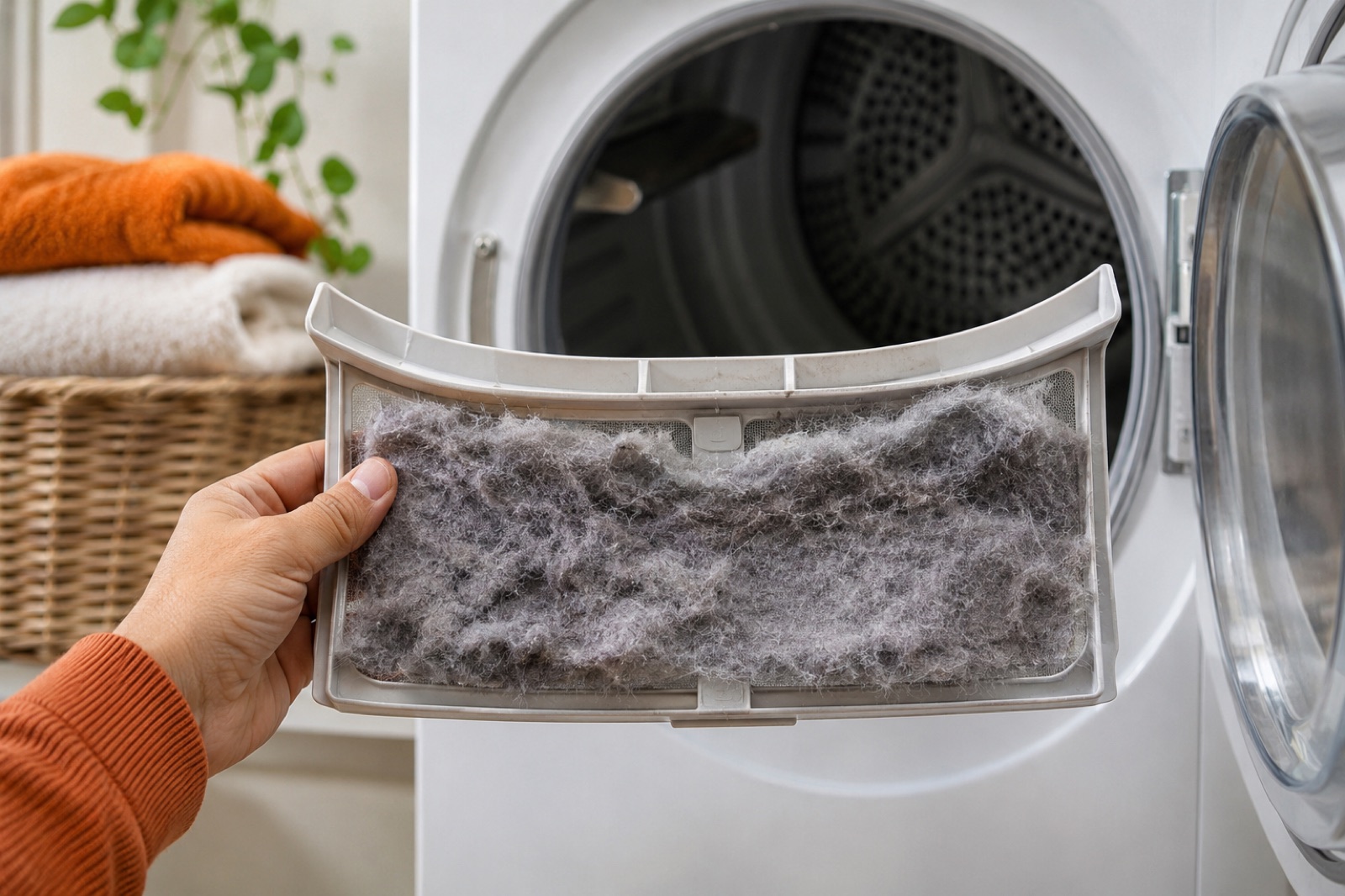
- Pull out the door or drum filter and remove all lint. Do this every load.
- Fabric softener and dryer sheets can leave a waxy film that blocks the mesh even when it looks clean. If water pools on the mesh instead of passing through, wash it gently with warm soapy water, then let it dry fully.
- Heat-pump dryers often have a second filter, sometimes foam, in the base. Clean it as the manual describes.
Check 2: The vent duct (vented dryers)
- With the dryer running, go outside and feel the vent flap. You should feel a strong flow of warm air. A weak flow points to a blockage.
- Check that the outside flap opens freely and is not blocked by lint, a nest or plants.
- Behind the dryer, check the duct is not crushed, kinked or longer than the manual allows. Thin plastic or foil ducts crush easily. Many manufacturers and fire agencies recommend rigid or semi-rigid metal duct.
- Cleaning a long duct run, especially through a wall or roof, is often best left to a professional dryer-vent cleaning service.
Check 3: Condenser and heat-pump dryers
- Empty the water tank every cycle, unless the dryer drains to a waste pipe.
- Clean the condenser or heat exchanger as often as the manual says. Lint builds up there and slows drying a lot.
- Heat-pump dryers dry more slowly in a cold room. Check the room temperature range in the manual.
Check 4: The load
- Overfilling stops clothes from tumbling and air from flowing. Try a smaller load.
- Clothes that come out of the washer very wet take much longer. Use a higher spin speed if your fabrics allow it.
- Sensor-dry programmes use metal strips inside the drum. If they are coated with softener residue, the dryer may stop early. Clean them as the manual describes.
Signs it needs a technician
- The drum turns but there is no heat at all after the checks above.
- A burning smell, scorch marks, or the outside of the dryer gets unusually hot.
- The drum does not turn, or you hear squealing, thumping or grinding.
- The breaker trips or the dryer shuts off mid-cycle repeatedly.
Check warranty and recalls before paying for a visit, using our guide to what to check first. Then compare quotes with the repair quote checklist.
Why it is worth fixing slow drying quickly
Every extra cycle costs electricity. If a load takes twice as long, it uses roughly twice the energy. Our guide on working out running costs shows how to put a number on that, and the running-cost calculator compares an old dryer with a new one.
Dryer taking too long to dry: causes by dryer type
| Dryer type | Most common cause | Check |
|---|---|---|
| All types | Full or waxy lint filter | Clean every load, wash if water pools on the mesh |
| All types | Overloading or very wet clothes | Smaller loads, higher spin in the washer |
| Vented | Crushed or blocked duct, stuck outside flap | Feel the airflow outside |
| Condenser | Clogged condenser, full water tank | Clean as the manual says, empty the tank |
| Heat pump | Dirty second filter or heat exchanger, cold room | Clean both, check room temperature |
| Any, with no heat at all | Heating or control fault | Technician |
Fixing a dryer taking too long to dry pays twice: shorter cycles cost less, and less lint means less fire risk.
Frequently asked questions
How often should the vent duct be cleaned?
Follow your manual and local fire-safety advice. Check the outside flow whenever drying slows down. Long or complex duct runs need more frequent attention.
Is it safe to run a dryer overnight?
Fire safety agencies advise against running dryers while you are asleep or out of the house.
My heat-pump dryer is slow. Is it broken?
Heat-pump dryers take longer than vented ones by design, and slow down further when filters or the heat exchanger are dirty or the room is cold. Clean everything the manual lists before assuming a fault.
Sources
Check for a recall before you pay for a repair
A recall can mean a free fix or replacement. Search with the model number from the rating plate. “No match” does not prove a machine is safe.