How to work out what an appliance costs to run
One multiplication turns an energy label into a yearly running cost. Here is where to find the numbers, how to compare an old machine with a new one, and the traps to avoid.
In this guide
Short answer: yearly running cost = energy use per year (kWh) × your electricity price per kWh. Find the energy use on the appliance's label or in its product sheet, find your price on your electricity bill, and multiply. Doing this for your old machine and a new one shows how much a replacement would save each year. Working out an appliance running cost takes one multiplication.
Key takeaways
- Use your own price per kWh, not a national average.
- Labels are measured under standard test conditions. Your real use may differ.
- For an old fridge with no label, a plug-in energy meter gives a real measurement.
- Compare like with like: similar size and features.
- A running-cost saving matters most over several years, so put it into a repair-or-replace comparison.
Step 1: Find the energy use
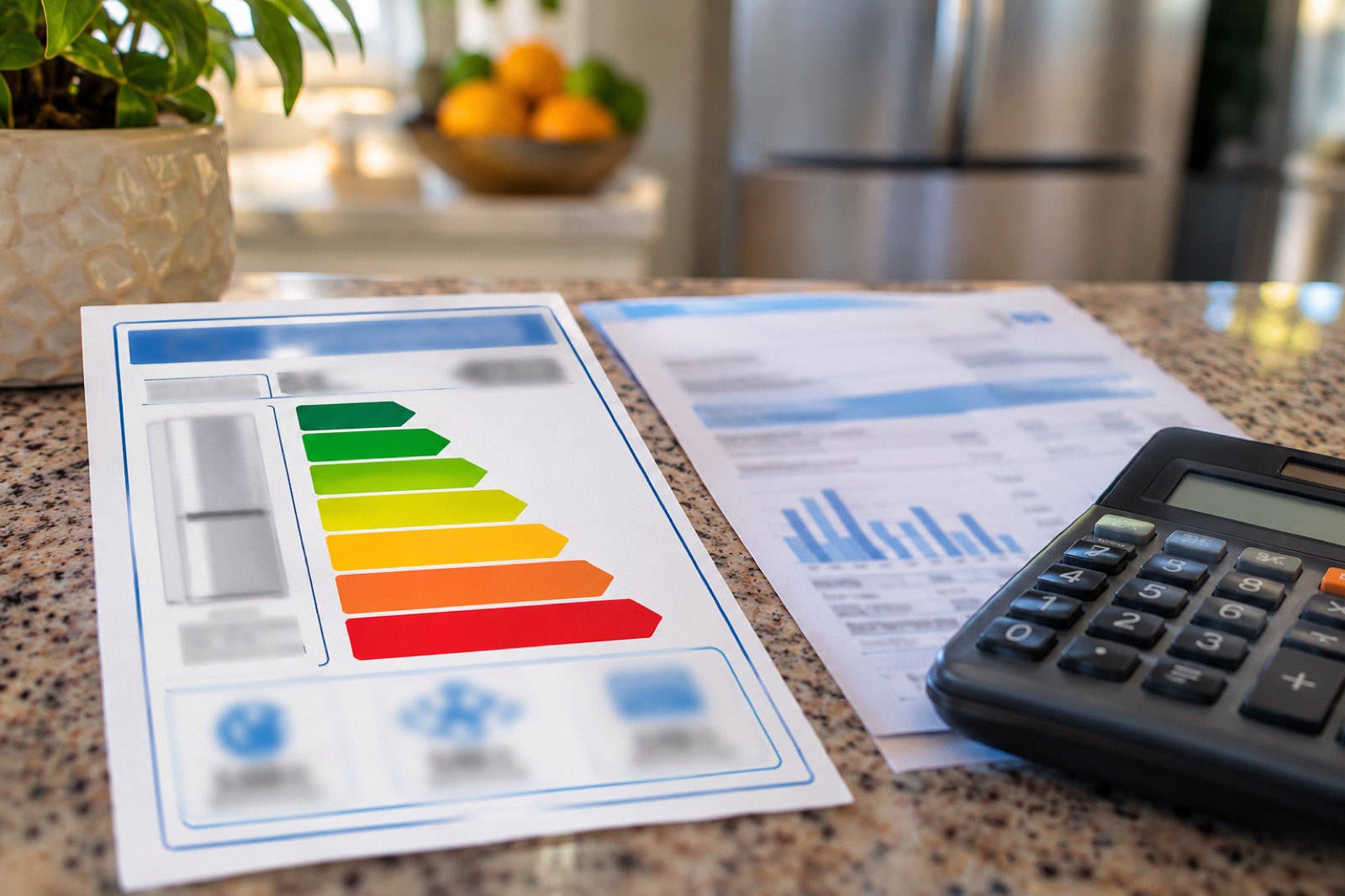
- United States: refrigerators, washers, dishwashers and many other appliances carry the yellow EnergyGuide label, showing estimated yearly energy use in kWh and an estimated yearly cost. The cost uses a national average price, so redo the sum with your own price.
- Australia: the Energy Rating Label shows energy use in kWh per year, alongside the star rating.
- Product sheets and online listings: the same figures are usually listed under specifications.
- Old appliance with no label: for a fridge or freezer, plug it into an energy meter for a full week and multiply by 52. For washers and dryers, measure several typical cycles and multiply by how many you run a year.
Step 2: Find your electricity price
Look on your bill for the price per kWh (sometimes called the usage or energy rate). Use the rate for the extra energy you use. Fixed daily or monthly charges do not change when you swap a fridge, so leave them out. If your price varies by time of day, use the rate for when the appliance usually runs, or an average across the day.
Step 3: Multiply
Yearly running cost = kWh per year × price per kWh.
Illustrative example (not your figures): an old fridge uses 600 kWh a year and a new one 350 kWh a year. At $0.30 per kWh:
| kWh per year | Cost per year | |
|---|---|---|
| Old fridge | 600 | 600 × $0.30 = $180 |
| New fridge | 350 | 350 × $0.30 = $105 |
| Saving | 250 | $75 per year |
Our running-cost calculator does this for you and keeps any cost you choose to leave out clearly labelled.
Washers, dishwashers and dryers: count your cycles
For machines you run in cycles, the energy depends on how often and how you use them. If a figure is given per cycle, multiply by the cycles you run in a year. For example, 4 loads a week is about 208 a year. Hot programmes use much more energy than cool ones. Washing machines and dishwashers also use water, which may be a cost worth adding if you pay for water by volume.
Traps to avoid
- The label's dollar figure: it uses an average price. Your price may be higher or lower.
- Different sizes: a bigger fridge uses more energy. Compare models that meet the same need.
- Short measurements: a fridge cycles on and off. Measure for days, not minutes.
- Counting the saving as profit: a yearly saving only matters next to what a replacement costs. Compare both over the same years in the repair-or-replace calculator.
Is a more efficient appliance worth it?
Sometimes. A $75 yearly saving adds up to $375 over five years, which may or may not cover the difference between repairing and replacing. Our guide on comparing over the same number of years shows how to bring the running costs into the decision.
Appliance running cost: quick reference
| Appliance | Where to find energy use | How to get a yearly figure |
|---|---|---|
| Fridge or freezer | Label (kWh per year) or energy meter | Label value, or one week measured × 52 |
| Washing machine | Label or product sheet | Per-cycle energy × cycles per year |
| Dishwasher | Label or product sheet | Per-cycle energy × cycles per year |
| Dryer | Product sheet or energy meter | Measured cycles × cycles per year |
Then multiply by your price per kWh. An appliance running cost worked out this way uses your real price, not a national average.
Frequently asked questions
How much electricity does a fridge use?
It varies widely with size, age, type and where it stands. Use the label for a new model and measure an old one with an energy meter, rather than relying on a general figure.
Where do I find my price per kWh?
On your electricity bill or in your online account, usually listed as the energy, usage or unit rate.
Should I count the fixed charges?
No. Fixed charges stay the same whichever appliance you have, so they do not affect the comparison.