Washing machine not draining: safe checks before you call for repair
Water left in the drum is often caused by a blocked filter or a kinked hose. Here is what you can safely check yourself, and when a technician is the better call.
In this guide
Short answer: when a washing machine will not drain, the most common causes are a blocked drain filter, a kinked or blocked drain hose, or a blocked sink or standpipe connection. You can check all three safely in under an hour. If the machine hums but no water moves after those checks, or it shows the same error code again, the drain pump or its controls may need a technician. Washing machine not draining? Start with the checks below before you book a repair.
Warning
Water and electricity do not mix. Switch the machine off and unplug it before you check anything. If the wash was hot, wait for the water to cool. If you smell burning, see scorch marks or the breaker trips, stop and call a professional.
What this guide covers
Front-loading and top-loading household washing machines. These checks are the kind most manufacturers describe in the user manual. Your manual for your exact model always takes priority. We do not cover opening the cabinet or testing electrical parts.
Before you start: rule out a setting
- Check the programme. Some programmes or options (for example a "rinse hold" or "no spin" setting) end with water in the drum on purpose.
- Note the error code on the display, if there is one, and look it up in the manual. It often points straight at a drain problem.
- Try a drain or spin-only programme once. If the water now drains, the problem may have been a heavy or unbalanced load.
Check 1: The drain hose
Pull the machine out gently, without stretching the hoses, and follow the drain hose from the back of the machine to where it empties.
- Look for kinks or a hose squashed behind the machine.
- If it hooks into a standpipe, check it is not pushed in too far. Too deep can cause siphoning or poor draining.
- If it connects to a sink trap, check that the trap and its spigot are clear. On a brand-new installation, a blanking cap left on the spigot is a classic cause.
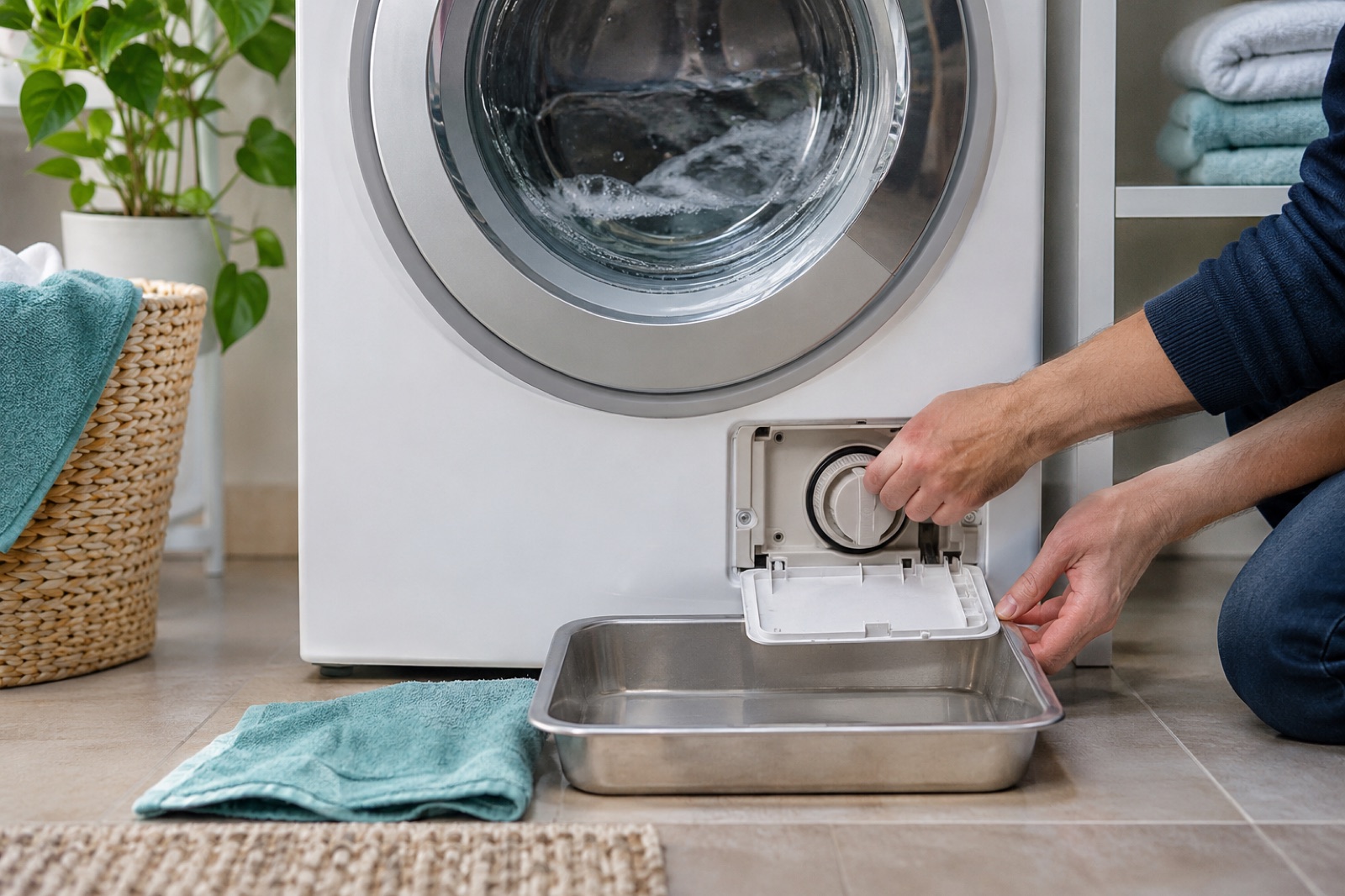
Check 2: The drain filter (pump filter)
Many front-loaders have a small filter behind a flap at the bottom front. It catches coins, hair clips, buttons and lint before they reach the pump. Top-loaders often do not have one you can reach. Check your manual.
- Unplug the machine and lay down towels. Put a shallow tray or baking dish in front. A lot of water can come out.
- If there is a small emergency drain hose next to the filter, use it to let the water out slowly into the tray.
- Unscrew the filter slowly, emptying the tray as often as needed.
- Clean the filter under the tap and check the opening for anything stuck. Do not put your fingers into the pump opening while it can turn.
- Screw the filter back in firmly and straight, so it does not leak.
Then plug in and run a rinse-and-spin programme. Watch for leaks around the filter flap.
Check 3: The house drain
If water backs up into the sink or out of the standpipe when the washer pumps, the blockage may be in your household drain rather than the machine. That is a plumbing job, not an appliance repair.
Signs it needs a technician
- The machine hums or clicks at the drain stage but no water moves, even with a clear filter and hose.
- There is no pump sound at all at the drain stage.
- The same drain error comes back after cleaning.
- The door stays locked with water inside and the manual's emergency steps do not help.
- Any burning smell, scorching or tripping breaker.
When you call, describe what you checked and the exact error code. That can shorten the diagnosis. Then compare quotes using our repair quote checklist.
Is it worth repairing?
A drain pump is usually a replaceable part, so this fault is often repairable. Whether it is worth it depends on the full quote, the warranty on the repair, the machine's running costs and the full cost of a replacement. Our guide on comparing over the same number of years explains how, and the repair-or-replace calculator does the sums with your figures.
Washing machine not draining: causes at a glance
| What you notice | Likely cause | What to do |
|---|---|---|
| Water left after a programme ends | "Rinse hold" or "no spin" option | Run a drain or spin programme |
| Slow draining, rattling | Coin, clip or lint in the drain filter | Clean the filter (Check 2) |
| No draining after a new install | Blanking cap left on the sink spigot | Remove the cap (Check 1) |
| Water backs up into the sink | Blocked household drain | Call a plumber |
| Humming, no water moving | Jammed or failed drain pump | Technician after filter check |
| No pump sound at all | Pump or control fault | Technician |
Most cases of a washing machine not draining fall into the first three rows, and you can fix those yourself.
Frequently asked questions
Can I keep using the washer if it drains slowly?
Clean the filter and check the hose first. If it still drains slowly, avoid running it unattended. Water left standing can leak, and a struggling pump can fail completely.
How often should I clean the drain filter?
Follow your manual. Many makers suggest checking it every few months, and straight away if the machine starts draining slowly or you hear rattling.
Why is there a bad smell from the washer?
Standing water, a dirty filter and residue in the door seal are common causes. Cleaning the filter and running the maintenance programme your manual recommends usually helps.
Sources
Check for a recall before you pay for a repair
A recall can mean a free fix or replacement. Search with the model number from the rating plate. “No match” does not prove a machine is safe.